

Draw The Molecule Listed Below.
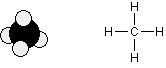
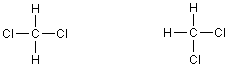
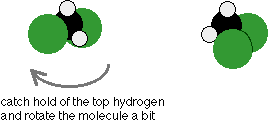
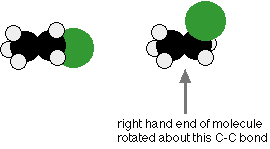
| DRAWING ORGANIC MOLECULES This page explains the various ways that organic molecules can exist represented on paper or on screen - including molecular formulae, and various forms of structural formulae. Molecular formulae A molecular formula simply counts the numbers of each sort of atom present in the molecule, merely tells you naught almost the way they are joined together. For case, the molecular formula of butane is CivH10, and the molecular formula of ethanol is C2H6O. Molecular formulae are very rarely used in organic chemistry, considering they don't give any useful information about the bonding in the molecule. About the but identify where you might come up beyond them is in equations for the combustion of uncomplicated hydrocarbons, for case: In cases like this, the bonding in the organic molecule isn't of import. Structural formulae A structural formula shows how the various atoms are bonded. There are diverse ways of drawing this and y'all will need to be familiar with all of them. Displayed formulae A displayed formula shows all the bonds in the molecule every bit private lines. You need to think that each line represents a pair of shared electrons. For example, this is a model of marsh gas together with its displayed formula: Observe that the fashion the marsh gas is fatigued bears no resemblance to the actual shape of the molecule. Methane isn't flat with 90° bond angles. This mismatch between what you draw and what the molecule actually looks like can atomic number 82 to problems if you aren't conscientious. For example, consider the simple molecule with the molecular formula CH2Cl2. You might call up that in that location were two unlike means of arranging these atoms if you drew a displayed formula. The chlorines could be opposite each other or at right angles to each other. Only these 2 structures are actually exactly the same. Look at how they announced as models. One structure is in reality a simple rotation of the other 1. | |
| Note:This is all much easier to understand if yous have actually got some models to play with. If your schoolhouse or college hasn't given you the opportunity to play effectually with molecular models in the early on stages of your organic chemistry course, you might consider getting agree of a inexpensive set up. The models made by Molymod are both inexpensive and like shooting fish in a barrel to employ. An introductory organic set is more than adequate. Google molymod to find a supplier and more virtually them, or search for molymod on Amazon. Share the cost with some friends, keep it in good condition and don't lose any bits, and resell information technology via eBay or Amazon at the end of your grade. Alternatively, get hold of some coloured Plasticene (or other children's modelling clay) and some used matches and brand your ain. It's cheaper, merely more difficult to become the bond angles right. | |
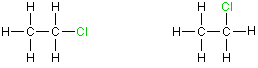
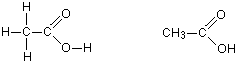
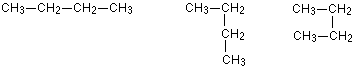
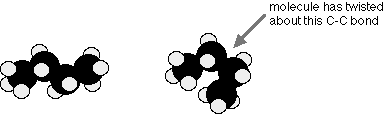
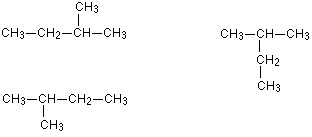
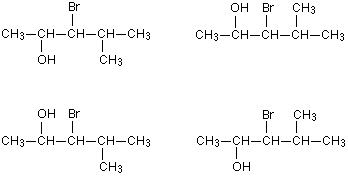
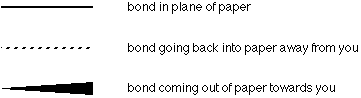
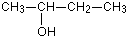
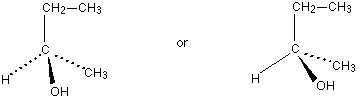
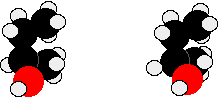
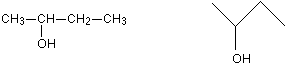
| Consider a slightly more complicated molecule, C2HvCl. The displayed formula could be written as either of these: But, again these are exactly the same. Expect at the models. The commonest manner to draw structural formulae For anything other than the near simple molecules, drawing a fully displayed formula is a bit of a bother - especially all the carbon-hydrogen bonds. You can simplify the formula by writing, for instance, CH3 or CHii instead of showing all these bonds. And so for instance, ethanoic acrid would be shown in a fully displayed form and a simplified form as: You could fifty-fifty condense it further to CHiiiCOOH, and would probably do this if you had to write a simple chemical equation involving ethanoic acid. You do, however, lose something by condensing the acid grouping in this way, because you can't immediately run into how the bonding works. You still take to exist careful in drawing structures in this way. Remember from above that these two structures both represent the same molecule: The side by side three structures all represent butane. All of these are just versions of four carbon atoms joined up in a line. The only difference is that there has been some rotation well-nigh some of the carbon-carbon bonds. You can come across this in a couple of models. Not one of the structural formulae accurately represents the shape of butane. The convention is that we describe it with all the carbon atoms in a straight line - as in the first of the structures above. This is even more important when yous start to have branched chains of carbon atoms. The post-obit structures again all represent the same molecule - 2-methylbutane. The two structures on the left are fairly evidently the aforementioned - all we've done is flip the molecule over. The other one isn't so obvious until you lot look at the structure in detail. There are four carbons joined up in a row, with a CHiii group attached to the next-to-end one. That'due south exactly the same as the other two structures. If you had a model, the only departure between these three diagrams is that you lot take rotated some of the bonds and turned the model around a flake. To overcome this possible confusion, the convention is that you lot always look for the longest possible chain of carbon atoms, so draw information technology horizontally. Anything else is simply hung off that chain. It doesn't matter in the to the lowest degree whether you draw any side groups pointing upwardly or down. All of the following represent exactly the same molecule. If you made a model of one of them, you could turn it into any other ane simply by rotating one or more of the carbon-carbon bonds. How to draw structural formulae in three-dimensions There are occasions when it is important to be able to show the precise three-D organization in parts of some molecules. To do this, the bonds are shown using conventional symbols: For case, you lot might want to show the 3-D organization of the groups around the carbon which has the -OH group in butan-2-ol. Butan-two-ol has the structural formula: Using conventional bond notation, you could draw information technology as, for example: The but difference between these is a slight rotation of the bail between the heart two carbon atoms. This is shown in the two models below. Look carefully at them - particularly at what has happened to the lone hydrogen atom. In the left-hand model, it is tucked behind the carbon cantlet. In the right-hand model, it is in the same airplane. The change is very slight. It doesn't matter in the least which of the 2 arrangements yous draw. Yous could easily invent other ones too. Choose one of them and get into the habit of drawing three-dimensional structures that way. My own habit (used elsewhere on this site) is to draw two bonds going back into the newspaper and one coming out - as in the left-hand diagram to a higher place. Notice that no attempt was made to show the whole molecule in 3-dimensions in the structural formula diagrams. The CHtwoCH3 group was left in a elementary form. Proceed diagrams simple - trying to evidence too much detail makes the whole matter amazingly difficult to empathise! Skeletal formulae In a skeletal formula, all the hydrogen atoms are removed from carbon chains, leaving just a carbon skeleton with functional groups fastened to it. For example, we've simply been talking about butan-two-ol. The normal structural formula and the skeletal formula look similar this: In a skeletal diagram of this sort
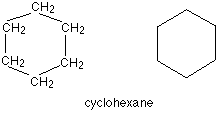
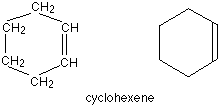
Beware! Diagrams of this sort have do to interpret correctly - and may well non exist acceptable to your examiners (see below). There are, however, some very common cases where they are frequently used. These cases involve rings of carbon atoms which are surprisingly awkward to draw tidily in a normal structural formula. Cyclohexane, Chalf dozenH12, is a ring of carbon atoms each with two hydrogens attached. This is what information technology looks similar in both a structural formula and a skeletal formula. And this is cyclohexene, which is similar but contains a double bond: Merely the commonest of all is the benzene band, C6Hsix, which has a special symbol of its own. | |
| Note:Explaining exactly what this structure means needs more infinite than is available here. It is explained in full in 2 pages on the structure of benzene elsewhere in this site. Information technology would probably be better not to follow this link unless you are actively interested in benzene chemistry at the moment - it will lead you off into quite deep h2o! | |
| Deciding which sort of formula to employ In that location's no easy, all-embracing answer to this problem. Information technology depends more than than annihilation else on feel - a feeling that a particular way of writing a formula is best for the situation you are dealing with. Don't worry most this - as you practice more and more organic chemical science, you lot volition probably discover it will come naturally. You'll become so used to writing formulae in reaction mechanisms, or for the structures for isomers, or in unproblematic chemical equations, that y'all won't even call up virtually it. There are, however, a few guidelines that you should follow. What does your syllabus say? Different examiners will accept different preferences. Cheque beginning with your syllabus. If you've downward-loaded a copy of your syllabus from your examiners' spider web site, information technology is piece of cake to check what they say they want. Use the "observe" role on your Adobe Acrobat Reader to search the organic section(s) of the syllabus for the word "formula". You should likewise check recent exam papers and (particulary) mark schemes to notice out what sort of formula the examiners actually prefer in given situations. You could also look at whatsoever support textile published by your examiners. | |
| Note:If you are working to a UK-based syllabus and haven't got a copy of that syllabus and recent exam papers, follow this link to find out how to become them. | |
| What if you still aren't sure? Draw the most detailed formula that you can fit into the space available. If in dubiousness, describe a fully displayed formula. You would never lose marks for giving also much detail. Apart from the most trivial cases (for example, called-for hydrocarbons), never use a molecular formula. Always show the particular around the important part(s) of a molecule. For example, the important part of an ethene molecule is the carbon-carbon double bond - so write (at the very to the lowest degree) CH2=CHii and not C2Hiv. Where a particular way of drawing a structure is important, this will always be pointed out where it arises elsewhere on this site.
© Jim Clark 2000 (modified November 2012) | |





Draw The Molecule Listed Below.,
Source: https://www.chemguide.co.uk/basicorg/conventions/draw.html
Posted by: johnsonsione1983.blogspot.com
0 Response to "Draw The Molecule Listed Below."
Post a Comment